
Trauma, Shame, and the Leader Within | The Breakdown Series
Jun 08, 2026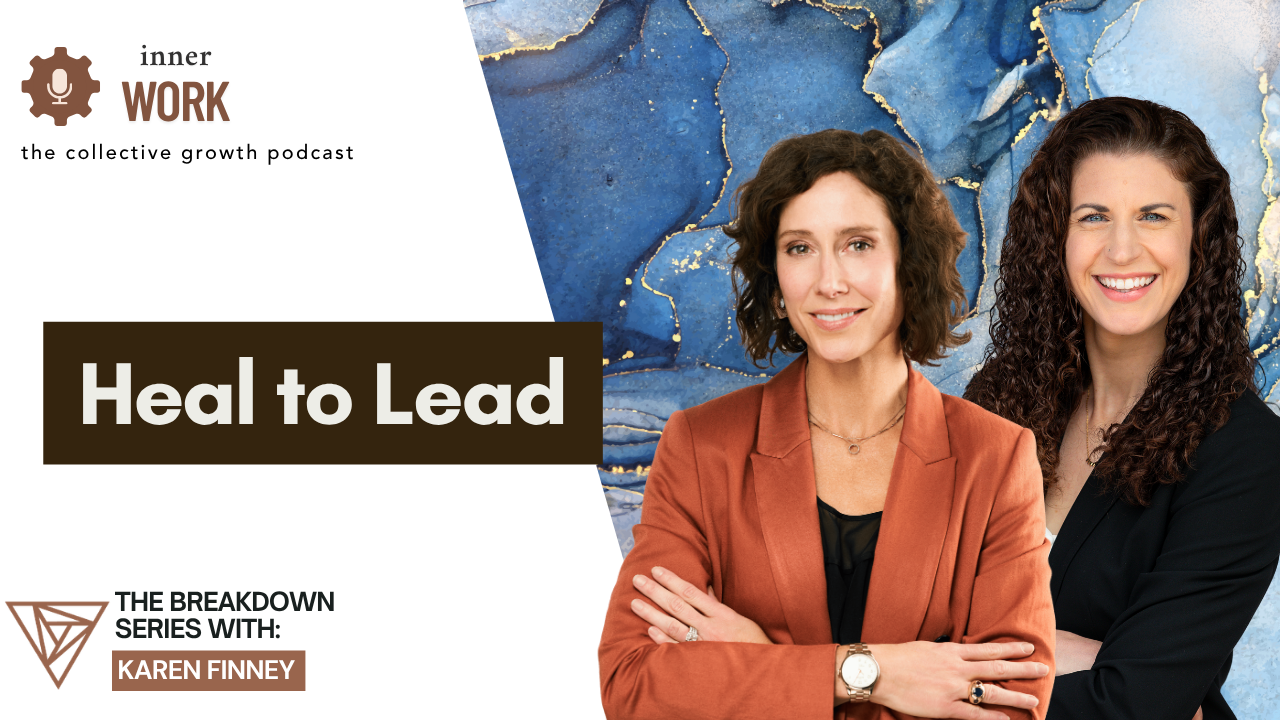
Most leaders are taught to keep parts of themselves out of the room.
Stay professional. Don't bring your story to work. Keep it together.
But hiding the wound doesn't make it disappear. It just drives every decision from a place the leader can no longer see.
In this Breakdown of Inner Work, MaryAnn Means-Dufrene and co-host Karen Finney revisit their earlier conversation with Carol Klocek, CEO of Center for Transforming Lives, about how childhood trauma — and the shame that grew around it — quietly shaped years of her leadership before she had the language for any of it.
What follows isn't a recap. It's the work underneath the work.
The Disruption: When Hiding Becomes Harm
Carol shared on the original episode that early in her career, a well-intentioned colleague told her not to talk about her family — to keep her story out of the room.
In the 1990s, that advice probably sounded like wisdom. In the context of that workplace, maybe it even was.
But she internalized something larger than the original suggestion. She heard: this part of you shouldn't be known. It will change how people see you.
"You're only as sick as your secrets," Karen said. "If something becomes a product of shame and secrecy and lives within us, it grows."
For years, the workplace kept evolving. Carol stayed stuck in the moment she'd been told to hide.
That's the part that struck MaryAnn most. One sentence from one person, magnified by a young leader's interpretation, can quietly drive decades of decisions.
The Inner Work: Healing Isn't Optional, It's the Job
"Is healing a requirement for leadership?" MaryAnn asked.
Karen took it further. "I'd take it a step further. Is it a requirement for life? I don't know if it's required. But man — are you missing out if you skip it."
That reframe sits at the center of this episode.
Because most leaders don't realize how many of their decisions are filtered through a self-concept that was built by survival, not by truth.
"How many of my decisions were based on a self-concept that wasn't accurate?" MaryAnn said. "Or based on what I thought it meant to be a CEO — instead of what was actually mine to do?"
The body keeps the score. The nervous system remembers what the logic brain has long since explained away.
"Of course it feels impossible to stop," MaryAnn said. "Your body trained you very well."
And Karen named the part most leaders skip: "You've been training your whole life to do this. So this idea of, let me just instantly, now that I have awareness, do it differently — no. You're unlearning decades of habitual response. Being gentle with ourselves through that process is the work."
The Rebuild: Trauma-Informed Teams and the Self-Critic You've Outgrown
So what does this actually look like inside a working environment?
Karen's framework: follow the trigger. The overreaction to feedback. The missed deadline. The procrastination that's really perfectionism. The chronic overwork.
These aren't always character flaws. They're often old protections showing up at work.
"Trauma is a continuum," Karen said. "Lowercase t. Capital T. But everybody's got something."
The shift isn't to become a therapist. It's to stop treating people's protective patterns like performance problems — and to build the kind of team where psychological safety and vulnerability can sit side by side.
The same logic applies inwardly.
Most high-performing leaders have a strong self-critic. The voice that got them here. The voice that drives them to push, to perform, to never coast.
"Is the self-critic still serving me?" Karen asked. "Or is it the thing now stopping me?"
The fix isn't to silence the critic. It's to stop letting it run the room alone. The self-critic gets a seat. The self-advocate gets a seat. The self-cheerleader does too.
And underneath all of it: managing your own gas tank.
"It's my job to manage my gas tank," Karen said. "Not anybody else's."
Sprints are part of the work. So is recovery. Burnout shows up when leaders run sprint after sprint with no walk-and-water in between — and one day the body announces, loudly, that the cost has been higher than the leader admitted.
What I Know Now: Curiosity Is the Doorway
MaryAnn asked for one final thought.
Karen offered curiosity.
"Curiosity is the gateway to empathy," she said. "With others. And with myself."
For most leaders trained in self-criticism, the inner monologue defaults to: why did I do that? Why can't I stop?
The reframe is quieter and more useful: hmm. Isn't that interesting. I wonder what was going on there.
Same noticing. Different tone.
That single shift — from interrogation to curiosity — opens the door to everything else this conversation pointed at. The healing. The trauma-informed team. The self-critic that finally takes a seat. The gas tank you actually keep an eye on.
Hiding the wound is not strength. It's the cost most leaders never name.
The leaders who do the work get to lead from a place they can actually see.
🎧 Listen to the full episode now!
FREE Team Conflict Assessment
Need help overcoming your Team’s most frustrating challenges? Click the button below to claim your FREE Team Conflict Assessment.
