
When Conflict Is the Whole Point | The Breakdown Series
Jun 22, 2026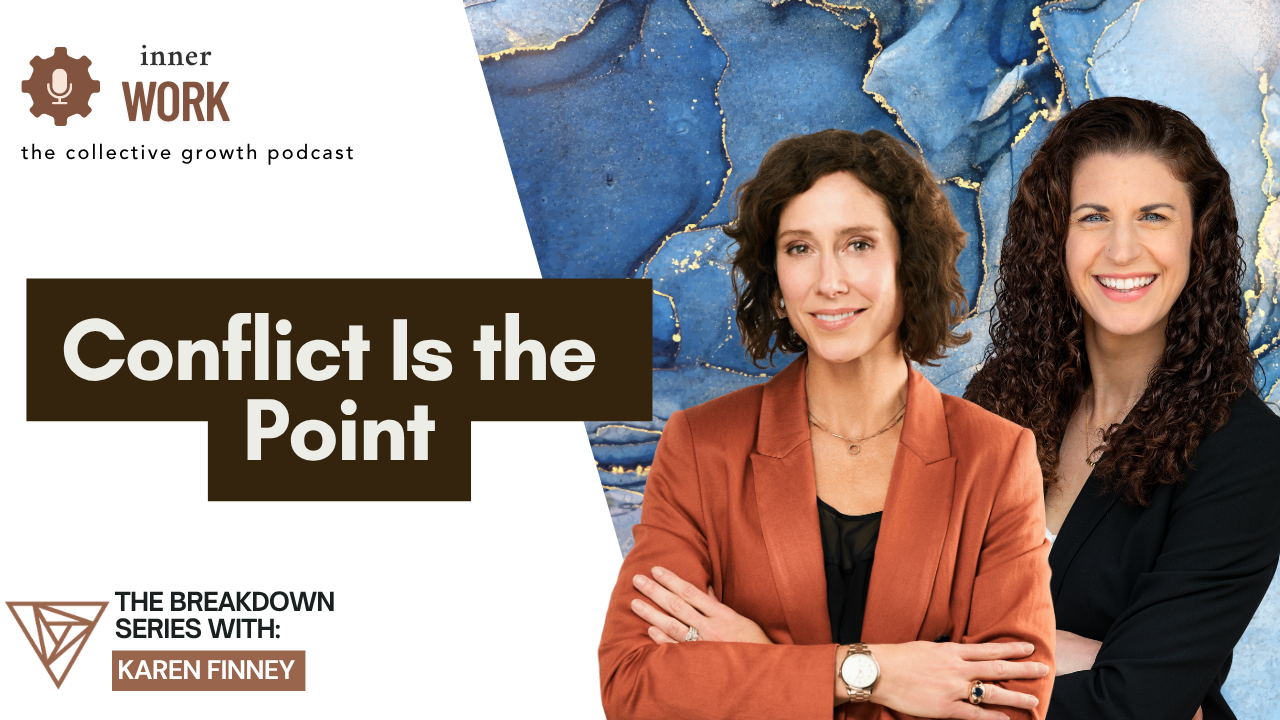
Most leaders are taught to manage conflict down.
The healthier ones learn that the absence of conflict is usually the more expensive problem.
A calm room isn't always a healthy room. Sometimes it's a room full of people quietly saving themselves the trouble of saying what they actually think.
In this Breakdown of Inner Work, MaryAnn Means-Dufrene and co-host Karen Finney revisit their conversation with Kellie Richter, Chief Operating Officer of First Command, about what changes when a leader stops protecting the calm and starts inviting the kind of disagreement that actually produces good decisions.
What follows isn't a recap. It's the work underneath the work.
The Disruption: The Yes-Person Problem
There's a version of leadership that looks like alignment from the outside and feels like nothing from the inside.
The room nods. The decisions get made. The team moves.
And then nothing executes the way it was supposed to.
"It's not actual harmony you have," MaryAnn said. "It's false harmony. People saying yes and then rolling their eyes behind your back."
Karen extended it: "You don't have anybody — people are afraid to tell you how they really feel. They feel like you value conformity, loyalty, whatever it looks like. And this is what that's costing you."
Most leaders never see the cost directly. They see the symptoms — execution drift, sluggish decisions, a sense that the team is moving but not quite together.
Kellie's reframe on the original episode landed because she didn't treat conflict as a thing to minimize. She treated it as a signal that people were actually engaged.
The Inner Work: Conflict Should Happen
"Spirited dialogue is important," Karen said. "If we're all just agreeing with each other, then we're not necessarily gonna get to the best outcome."
That sounds obvious in the abstract. It is not obvious in practice.
Because most leaders, when they've worked hard for their seat, want the room to back the decision. Disagreement reads as risk. Pushback feels like erosion of authority.
The shift is uncomfortable, and it's the work.
Kellie told a story about getting crossways with a colleague — and not letting it stay private. She named the conflict, took ownership of how she'd shown up, and modeled apology in front of her team.
"Just because you reach a certain level doesn't mean you're exempt from these things or that you don't hold yourself accountable," Karen said. "Apologize in the moments where you need to apologize. That is so important."
The lesson wasn't that there had been conflict. It was that the leader didn't hide from her part of it.
That's what makes the next conflict safer for everyone else.
The Rebuild: Telling Stops Working. Coaching Starts Working.
Kellie's other thread was about what changes when a leader cares about the person before the message.
"It's not just telling people, this is what you need to do," Karen reframed. "Coaching is really other-focused. It's thinking about that other person versus, here's the message I need to give you."
Telling is fast. It's also one-directional.
Coaching is slower. It requires the leader to know what the other person actually wants for themselves — and to frame the conversation through that lens.
"When people know that you care about them and you care about what matters to them," Karen said, "they are more receptive to any idea you're going to put in front of them."
This is the work most leaders skip when they're under pressure. They default to telling. The team learns to default to compliance.
Underneath this, Kellie offered a simple operating system: her three Cs.
Clarity. Consistency. Control.
Clarity, because most breakdowns trace back to a leader who thought the message landed and a team that didn't actually know what was being asked.
Consistency, because what people experience repeatedly is what they believe — not what gets said in the kickoff.
Control, because the only useful question for a team under pressure is what's actually inside its lane.
"You're showing that you're somebody who bothers to have a philosophy that is well thought out and easy to remember and explain," MaryAnn said. "Those are the things that are catchy."
What I Know Now: One Experience, Inside and Out
Kellie's marketing background gave her a phrase most operations leaders don't reach for: authentic brand experience.
The leverage in the phrase isn't the brand part. It's the authentic part.
"We're not trying to manage multiple faces in terms of, this is how we are internally, this is how we are externally," Karen said. "That's exhausting. Authenticity is, we are who we say we are."
One experience. Walked, not announced.
That's what makes the conflict productive instead of destabilizing. That's what makes the coaching land instead of read as performance. That's what makes the 3 Cs a system instead of a slide.
The leaders who run from conflict are usually trying to protect something that's already cracking.
The leaders who invite it — and model accountability when it's their turn to apologize — are the ones whose teams actually trust the alignment.
🎧 Listen to the full episode now!
FREE Team Conflict Assessment
Need help overcoming your Team’s most frustrating challenges? Click the button below to claim your FREE Team Conflict Assessment.
